Rain falls, and many tons of rain may impact on earth in an hour or so. On bare soils and thinly spaced or cultivated crop, the impact of droplets carries away soil, and may typically remove 80 t / ha, or up to 1,000 tonnes in extreme downpours. When we bare the soil, we lose the earth.
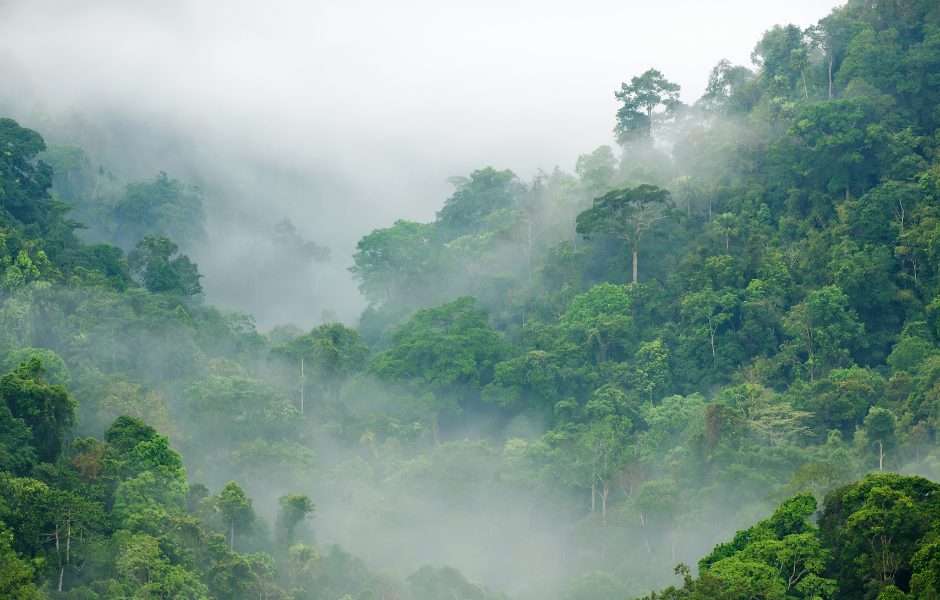
But when rain falls on a forest, a complex process begins. Firstly, the tree canopy shelters and nullifies the impact effect of raindrops, reducing the rain to a thin mist below the canopy, even in the most torrential showers. There is a slight measurable silt loss from mature forests, exceeded by the creation of soils by forests.
WATER CYCLE
The water in the air is that evaporated from the surface of the sea or lake. A small proportion of may fall as rain (15-20%), but most of this water is CONDENSED out of clear night air or fogs by the cool surfaces of leaves (80-85%). Of this condensate, 25% evaporates by day and 50% is transpired. The rest, 25%, enters the groundwater. Thus, trees are responsible for more water in streams than the rainfall alone provides.
This moisture, through evaporation and transpiration, is added to clouds. These clouds travel on inland to rain again, and the cycle continues. Thus trees may double or multiply rainfall itself by this process, which can be repeated many times over extensive forested plains or foothills.
more on 25% that enters GROUND WATER
This water passes through a tree canopy, known as THROUGHFALL. At this point, it is no longer just rainwater. It contains many plant cells and nutrients, and is in fact a much richer brew than rainwater.
The results show that rain washes large amounts of potassium and smaller amounts of nitrogen, phosphorous, calcium, and magnesium from the canopies to the surface soil. Litter adds organic matter, and is a rich source of calcium and nitrogen and a moderately rich source of magnesium and potassium.
Murray, J. S. and mitchell, A., red gum and the nutrient balance, soil conservation authority, victoria, australia
In the stem bases of palms, plantains, and many epiphytes, or the flanged roots of Terminalia trees and figs, water is held as aerial ponds, often rich in algae.
With the aerial reservoirs filled, the water now enters the humus layer of the forest, which can itself (like a huge sponge) absorb 1cm of rain for every 3cm of depth. In an undisturbed rainforest, deep mosses carpet the forest floor. So, for 40-60cm depth, the throughfall is absorbed by the decomposers and living systems of the humus layer. Again, the composition of the water changes, picking up humic exudates.
Below the humus lies the tree roots, each clothed in fungal hyphae and the gels secreted by bacterial colonies. 30-40% of the bulk of the tree itself lies in the soil. If we imagine the visible (above ground) forest as water (and all but above 5-10% of this mass is water), and then imagine the water contained in soil, humus, and root material, the forests represent great lakes of actively managed and actively recycled water.
No other storage system is so beneficial, or results in so much useful growth.
Thus, it almost seems as though the purpose of the forests is to give soil time and means to hold fresh water on land.
Thus, if we clear the forest, what is left but dust?
Leave a Reply